Two Theories of County Government, on Display in a Church Pew
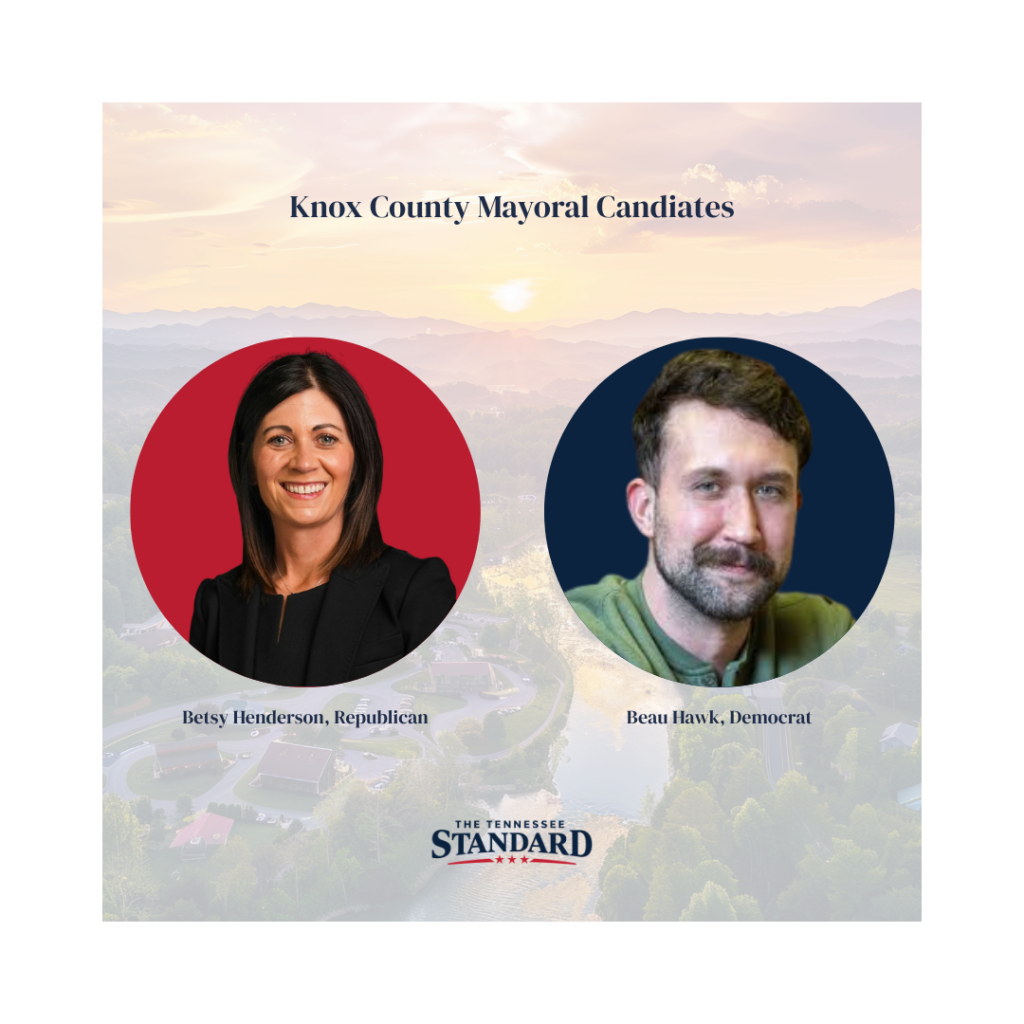
A forum meant to introduce two mayoral candidates instead exposed the deeper argument Knox County is about to settle: whether opportunity comes from restraint or from investment. Three weeks before Knox County voters choose their next mayor, Republican Betsy Henderson and Democrat Beau Hawk sat before a room of their future constituents at the Church of the Nazarene on Tuesday night and did something increasingly rare in American politics: they answered the questions actually being asked of them, plainly, and let the differences speak for themselves.
There was no moderator theatrics, no viral moment engineered for social media. Voters simply lined up with more than a dozen questions, and the two candidates, a school board chair who has spent six years fighting budget battles and a labor union president who has spent a career negotiating them, worked through roads, schools, and taxes in the unglamorous detail that county government actually requires.
Henderson’s campaign narrative fuses faith, family, and fiscal restraint into a single account of what shaped her; Hawk’s fuses solidarity, labor, and material security into his.
By the end of the evening, one exchange had risen above the rest, both in the number of times it was asked and in what it revealed about the choice before Knox County. The subject was Tennessee’s Education Freedom Scholarship program, the statewide school-choice initiative that allows public education dollars to follow a student to a private school. Henderson reaffirmed her support for it, while committing to fully fund the county’s public schools regardless. Hawk rejected it outright, arguing the program siphons resources from a public system already strained by growth.
It is tempting to treat that as one item on a long list. It is better understood as the evening’s organizing question, because it forced both candidates to state, in front of voters, what they believe county government is actually for.
The Argument Over School Choice
Henderson’s position was not a reluctant one. As a two-term member and former chair of the Knox County Board of Education, she has built her public career around the idea that parents, not institutions, should hold the final say over a child’s education. She has described her role in keeping schools physically open through the pandemic, opposing mask mandates, and preserving school resource officers as evidence of that conviction. Her support for education freedom scholarships fits the same pattern: expand the range of options available to families, without treating that expansion as a threat to the public system she has spent years overseeing. She has pointed to a teacher pay increase secured on her watch (funded, she says, by paying down debt rather than raising taxes) as proof that public schools need not lose out for parents to gain choices.
Hawk’s objection was equally direct, and equally rooted in his own record. He is not a figure who has spent his career inside the school system; he has spent it representing tradespeople through the Knoxville-Oak Ridge Central Labor Council. His skepticism of the scholarship program tracks his broader instinct that public institutions deserve reinforcement, not competition, and that a dollar diverted from the county’s schools is a dollar the district cannot recover. It is a coherent, defensible view, and it plainly resonates: voters in attendance who supported Hawk cited it as their reason, with one noting that teachers she knows personally had lost positions and another arguing flatly that public money belongs in public schools.
Both positions deserve to be taken on their merits rather than dismissed as slogans. The case for choice rests on a wager that competition improves outcomes and that parents, closer to their own children than any bureaucracy, are the appropriate decision-makers, a wager with real evidence behind it in states that have tried it, though not without legitimate questions about transition costs for districts that lose enrollment. The case against it rests on a wager that a public system serves the community best when its funding is stable and undivided, and that per-pupil losses compound faster than a growing county can absorb them. Reasonable people, weighing the same facts, land in different places. But it is difficult to argue that Henderson’s position, choice paired with an explicit funding commitment to the public system, is not the more fiscally cautious of the two, precisely because it tries to have both rather than forcing a binary trade-off.
Two Theories of the Budget
The tax conversation that followed drew the same line more starkly. Henderson has staked her campaign on a number: Knox County has not raised property taxes since 1999, and its budget has nonetheless grown from $423 million to $1.1 billion through what she calls natural growth and disciplined spending. Her governing theory is essentially a household one: government should live within its means the way a family or small business must, and further growth should be captured through economic development rather than extracted through higher rates.
Hawk does not propose raising taxes on working families either, but he declines to make Henderson’s blanket pledge, arguing that the county’s infrastructure backlog and stagnant wages leave little room for absolutism. His preferred mechanism, a different property tax structure for corporate land use, reflects his broader theory that the cost of the county’s rapid growth should not fall disproportionately on residents who did not create it.
This is where the two candidates’ backgrounds matter more than their biographies alone would suggest. Henderson’s economic view was shaped inside a public institution defending its budget against expansion pressure; Hawk’s was shaped representing workers negotiating for a larger share of growth they helped build. Both experiences are legitimate lenses on county government. But only one of them treats the absence of a tax increase as an achievement worth defending rather than a constraint to be managed around. And a county that has quadrupled its budget without raising rates has at least demonstrated that restraint and growth are not mutually exclusive, whatever the fairest distribution of that growth’s costs turns out to be.
Faith, Largely Unspoken
It is worth noting what the setting implied but the transcript did not fully bear out: for an evening held inside a church sanctuary, faith itself was rarely the explicit subject. Henderson’s public biography leans on it more openly than Hawk’s: she has spoken of being raised in the Greek Orthodox tradition of her immigrant father and of her family’s current life in a Presbyterian congregation, framing it as part of the same inheritance that produced her belief in personal responsibility and hard work. Hawk’s public record centers less on personal faith and more on institutional coalition-building; he has spoken elsewhere of labor and faith-based organizations partnering on shared community projects, a notably different register: solidarity between institutions rather than a personal testimony. Neither approach is disqualifying, but the asymmetry is itself telling. Henderson’s campaign narrative fuses faith, family, and fiscal restraint into a single account of what shaped her; Hawk’s fuses solidarity, labor, and material security into his. Voters weighing “faith” as a criterion should recognize they are being offered two different definitions of the word: one personal and confessional, one civic and coalitional.
It is difficult to argue that Henderson’s position, choice paired with an explicit funding commitment to the public system, is not the more fiscally cautious of the two, precisely because it tries to have both rather than forcing a binary trade-off.
What the Forum Actually Decided
No forum settles an election, and this one did not attempt to. But it did something more useful than a debate designed for viral clips: it let two capable, sincere candidates describe, unprompted and at length, what they believe a county government owes its residents. Henderson’s answer is that it owes them restraint, choice, and the confidence that a family’s decisions about taxes, schools, and safety are better made by the family than the government. Hawk’s answer is that it owes them investment, protection for the institutions that hold a growing community together, and a check against the costs of growth falling on those least able to absorb them.
Knox County is growing fast enough that both theories will be tested regardless of who wins. The candidate better positioned to manage that growth without abandoning the discipline that got the county here (a budget nearly tripled without a single rate increase in a quarter-century) has the stronger claim on August 6. But the county owes Beau Hawk’s supporters an honest acknowledgment that his worry about strained public schools and workers left behind by growth is not manufactured; it is the predictable cost of the very prosperity Knox County is trying to manage.